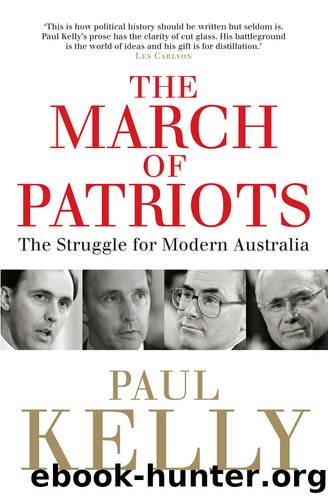
The March of Patriots: The Struggle for Modern Australia by Paul Kelly
Author:Paul Kelly [Kelly, Paul]
Language: eng
Format: epub
Tags: Australia & New Zealand, Political Science, World, History, Politics, General
ISBN: 9780522857382
Google: EuqFg5dUmgQC
Goodreads: 13197506
Publisher: Melbourne University Press
Published: 2009-01-01T00:00:00+00:00
27
CONFRONTATION ON THE WATERFRONT
Very few politicians will risk their career for their beliefs, but thatâs what Peter Reith did.
âChris Corrigan, April 2008
Peter Reithâs tragedy is that of a man who lost his dream, his clout and finally his career. In Shakespearean fashion Reith was compromised by the weapons he used on the waterfront: the negotiator of 1996 became the agent of confrontation of 1998. Reith had a courage rare in politics that cast him as both hero and demon.
It began with Reithâs drive to reform the Australian waterfront and break the power of the Maritime Union of Australia (MUA), an icon of monopoly union power. The upshot was a reprise of class warfare, a conflagration where the government lost the propaganda contest and provoked adverse judgments from the Federal Court. This brought Reith to a 1998 career crisis. He said:
The Howard government was feeling very fragile. The truth is that when it comes to a real fight few people are ready to commit. I was pretty isolated. When we discussed the situation in cabinet I was surprised that Peter Costello attacked me over the [Federal Court] decision. Itâs probably the only thing I cannot forgive him. Unfortunately Downer wasnât there that day and Amanda Vanstone was just about my only backer [apart from] Howard.1
Reith was the last man to offer his head but he needed a signal of Howardâs support. âIt was one night at Kirribilli House,â Reith said.
I reviewed the options with Howard. I trusted him and could talk to him about my own and the governmentâs situation. I put before him all the options, including my resignation if that was the best political course. Of course, I didnât think it was the best option and I didnât think Howard would either.2
Howard would not countenance the loss of Reith. âYou are not going to resign under any circumstances,â he replied.3 These men were warriors of many years and Reith was probably the minister closest to Howard. The Prime Minister would not tolerate giving Reithâs political head to the detested MUAâhell would have to freeze over.
Interviewed nearly a decade later, Howard was unrepentant. âReith was doing the will of the government,â he said. âWe wanted this reform. Peter felt embarrassed about the way the court action went. We did very badly. I said we are not going to lose an outstanding minister on that account. I think Reith did a fantastic job with the waterfront dispute.â4
For Reith, who saw himself as a future leadership contender, the waterfront offered a contrast with Costello. The cautious Costello would never exhibit the risk and confrontation that Reith entertained.
In an equivocal outcome Reith won a far more efficient waterfront, while the MUA kept its monopoly and lost its bargaining power. Reith was defined as a polarising agent of division, a minister identified with âdogs and balaclavasâ for night enforcement. He was seen as ruthless rather than strong. Reith canvassed the resignation option with Howard because, at the time, he had become a liability.
The waterfront battle frightened moderate opinion.
Download
This site does not store any files on its server. We only index and link to content provided by other sites. Please contact the content providers to delete copyright contents if any and email us, we'll remove relevant links or contents immediately.
| Arms Control | Diplomacy |
| Security | Trades & Tariffs |
| Treaties | African |
| Asian | Australian & Oceanian |
| Canadian | Caribbean & Latin American |
| European | Middle Eastern |
| Russian & Former Soviet Union |
The Secret History by Donna Tartt(19085)
The Social Justice Warrior Handbook by Lisa De Pasquale(12190)
Thirteen Reasons Why by Jay Asher(8909)
This Is How You Lose Her by Junot Diaz(6885)
Weapons of Math Destruction by Cathy O'Neil(6279)
Zero to One by Peter Thiel(5801)
Beartown by Fredrik Backman(5751)
The Myth of the Strong Leader by Archie Brown(5507)
The Fire Next Time by James Baldwin(5442)
How Democracies Die by Steven Levitsky & Daniel Ziblatt(5218)
Promise Me, Dad by Joe Biden(5153)
Stone's Rules by Roger Stone(5087)
A Higher Loyalty: Truth, Lies, and Leadership by James Comey(4960)
100 Deadly Skills by Clint Emerson(4924)
Rise and Kill First by Ronen Bergman(4788)
Secrecy World by Jake Bernstein(4752)
The David Icke Guide to the Global Conspiracy (and how to end it) by David Icke(4717)
The Farm by Tom Rob Smith(4507)
The Doomsday Machine by Daniel Ellsberg(4490)
